Are you a Sydney business owner tired of seeing your electricity bills climb higher each quarter? You might be paying for electricity that you aren’t even using effectively. This is where power factor correction comes in. This guide will simply explain what power factor is, why it’s costing your business money, and how a straightforward fix can significantly lower your energy costs and improve your operational efficiency.
What is Power Factor? A Simple Explanation
In simple terms, think of power factor as an ‘efficiency rating’ for how your business consumes electricity. This rating is measured on a scale from 0 to 1.0, where a perfect score of 1.0 (or 100%) means you are using every bit of power delivered to your site effectively. However, most commercial and industrial sites have a lower score because of equipment like motors, air conditioning units, and even fluorescent lighting, leading to significant energy waste.
The Beer Analogy: Understanding Your Power Bill
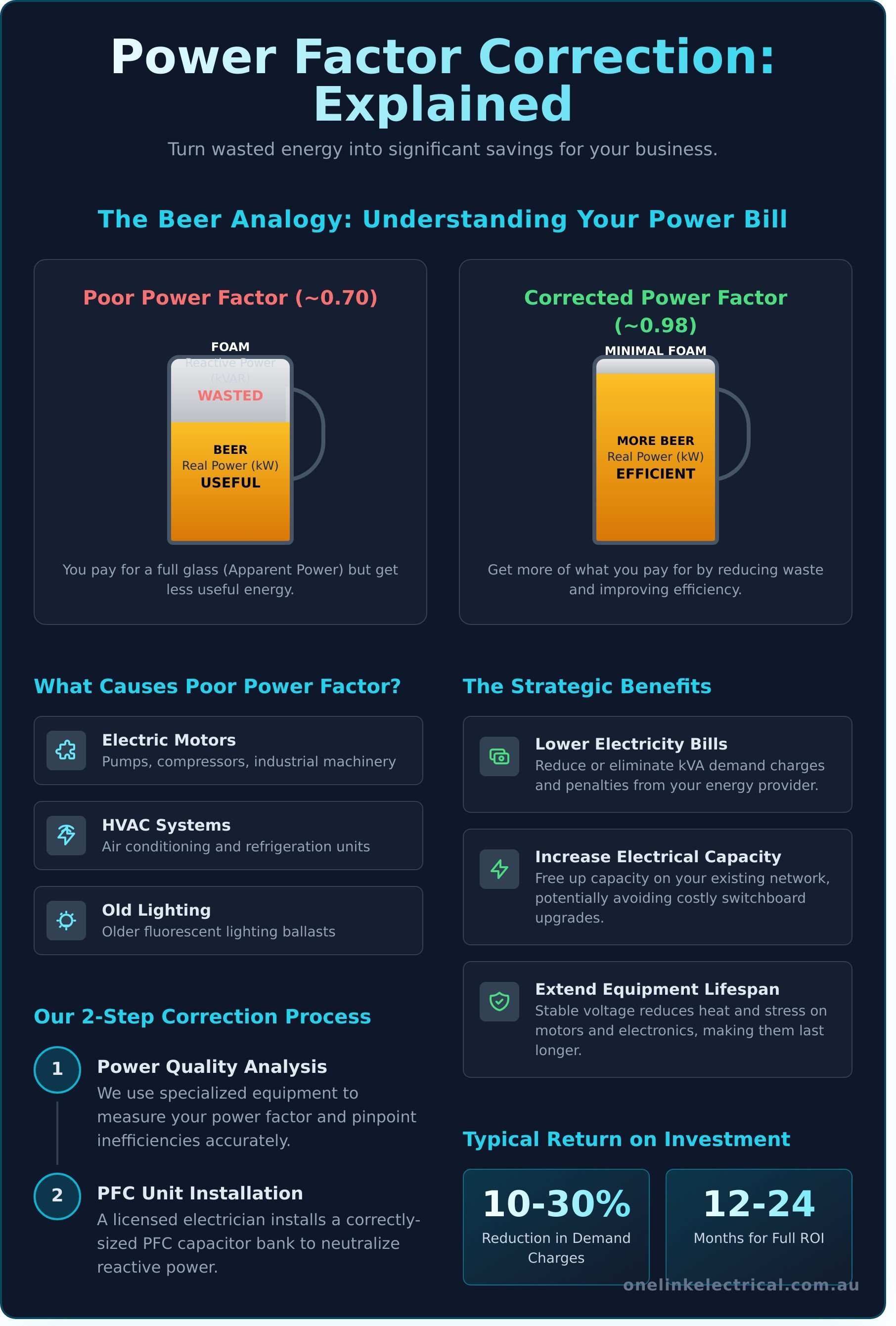
The easiest way to understand power factor is to imagine a glass of beer. The total liquid in the glass represents the ‘Apparent Power’ (measured in kVA), which is what the energy provider delivers to you and, ultimately, what you are billed for.
- The beer itself is the ‘Real Power’ (kW). This is the useful power that runs your machinery, computers, and lights. It does all the actual work.
- The foam on top is the ‘Reactive Power’ (kVAR). This power is necessary to create the magnetic fields for motors and other equipment to run, but it performs no useful work. It’s a necessary byproduct.
A poor power factor means you have too much foam in your glass. You’re paying for a full glass (Apparent Power) but only getting the benefit of the actual beer (Real Power). Power factor correction is the process of reducing the foam, so you get more of what you pay for.
What Causes a Poor Power Factor in a Business?
A poor power factor is primarily caused by ‘inductive loads’. These are common in almost every commercial setting in Sydney. The most frequent culprits include electric motors, HVAC systems, industrial pumps, compressors, and older fluorescent lighting ballasts. This equipment requires reactive power (the ‘foam’) to operate, which lowers your overall power efficiency and drives up your costs.
The Benefits: Why Power Factor Correction is a Smart Investment
Improving your power factor isn’t just a technical adjustment; it’s a strategic financial decision that directly impacts your bottom line. For many businesses, it’s one of the most effective and quickest ways to cut down on energy waste and operational costs.
1. Lower Your Sydney Electricity Bills
Energy suppliers in NSW can penalise businesses that have a poor power factor. These penalties often appear on your bill as ‘demand charges’ or ‘kVA charges’. By installing power factor correction equipment, you reduce these specific charges, leading to immediate and significant monthly savings on your electricity bills.
2. Increase Your Electrical System’s Capacity
By improving your energy efficiency, you free up valuable capacity on your existing switchboard and electrical network. This means you can often add more machinery or equipment without needing a costly and disruptive switchboard upgrade or new service installation. It helps you avoid major capital expenditure while allowing your business to grow.
3. Improve Voltage and Extend Equipment Life
A poor power factor can cause voltage drops and fluctuations within your facility. This instability puts unnecessary stress on your electrical equipment, particularly motors, causing them to run hotter and less efficiently. Correcting your power factor stabilises the voltage, leading to cooler operation, better performance, and a longer, more reliable lifespan for your expensive assets.
How We Fix It: The Power Factor Correction Process
The solution to a poor power factor is to install a dedicated Power Factor Correction (PFC) unit. This is a specialised task that must be handled by a licensed and experienced commercial electrician to ensure it’s done safely and sized correctly for your specific needs.
Step 1: Power Quality Analysis
The first step is never guesswork. Our qualified electricians use specialised power quality analysers to measure your electrical system’s performance. We gather precise data to determine your current power factor and identify the main sources of inefficiency. This detailed analysis ensures we design and recommend the perfect solution for maximum savings.
Step 2: Installing PFC Capacitor Banks
PFC units are essentially banks of capacitors that work to counteract the reactive power (the ‘foam’ in our beer analogy) being drawn by your equipment. Once installed, the unit intelligently supplies reactive power locally, so you don’t have to draw it from the grid. Our team plans every installation carefully to minimise any disruption to your business operations.
Is Power Factor Correction Right for Your Business?
This solution is particularly beneficial for businesses with high electricity consumption, such as manufacturing plants, warehouses, data centres, large office buildings, and refrigerated facilities. If your operations rely on multiple large motors, pumps, or extensive HVAC systems, you are an ideal candidate to benefit from power factor correction. The best way to know for sure is with a professional assessment. Book a $0 call-out power audit with our Sydney experts.
Frequently Asked Questions
How much money can power factor correction save my business?
Savings vary depending on your current power factor and energy usage, but many businesses see a reduction of 10-30% in their demand charges, leading to thousands of dollars in annual savings.
What is the typical return on investment (ROI) for a PFC unit?
The ROI is typically very fast, often between 12 to 24 months. After the payback period, the savings on your electricity bill continue for the life of the equipment.
Will the installation process shut down my business?
We understand that downtime is costly. We plan installations meticulously and can often schedule the work during off-peak hours or weekends to ensure minimal to no disruption to your operations.
What are the signs that my business has a poor power factor?
Besides high electricity bills, signs can include flickering lights, voltage drops when large equipment starts, and motors or transformers overheating.
Is power factor correction a legal requirement in NSW?
While not a legal requirement, energy providers are permitted to charge you more for having a poor power factor. It’s a financial incentive to be more efficient, not a legal mandate.
Can a PFC unit damage my electrical equipment?
No, when professionally specified and installed, a PFC unit actually protects your equipment by providing stable voltage, reducing stress on motors and electronics.
Don’t let inefficient power consumption drain your profits any longer. Taking control of your power factor is a proactive step toward a more efficient, reliable, and cost-effective business operation. Our team of licensed commercial electricians in Sydney has the expertise to analyse your needs and deliver a solution with a guaranteed return on investment. Stop wasting money on electricity. Request your Power Audit today!